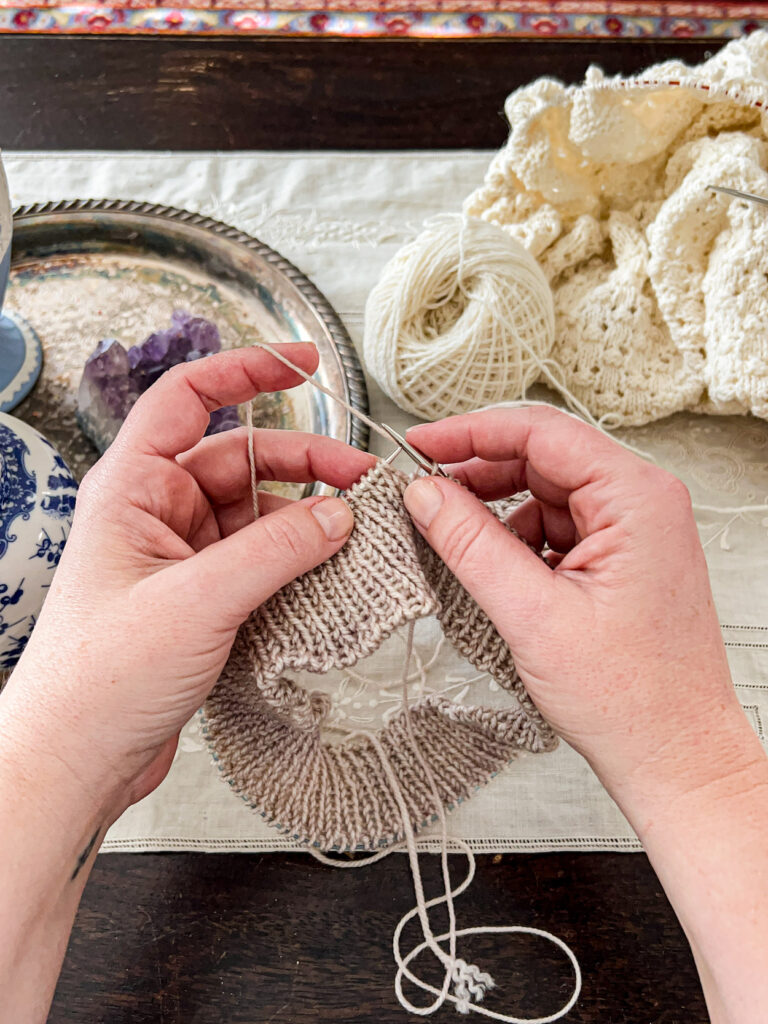
One great aspect of knitting is that no matter how long you’ve been doing it, there’s always more to learn. Conversely, knitting is also one of those activities that improves with experience. The more experience you develop, the more you notice about your knitting that you can use to further improve your skills.

In today’s post, we’re looking at five things that I learned to pay attention to as I gained knitting experience. These five things will help you improve your own knitting projects, too.
What is an experienced knitter?
Before we dive in, though, I think we need to clarify what makes somebody an experienced knitter. It’s not just a function of the amount of time you have been knitting.
Somebody can be a knitter of 50 years, but if they’ve never ventured beyond a few different stitches or one specific type of project, they still may not have the experience needed to spot some of these things. On the other hand, somebody else may have been knitting for only a few years, but they have been diligent about building skills and learning techniques.
When I think about experienced knitters, I picture knitters who have spent some time dedicating themselves to learning the finer points of the craft. Maybe they have taken some classes at their local yarn shop or a fiber festival. They might have devoured knitting books that explain techniques and yarn construction. Others will have tackled a wide variety of projects.
There are many ways to become an experienced knitter. You don’t have to go back to school and do a multi-year program to become one (though that is certainly a cool option, and I would love to do it!).
Now that we’ve got that out of the way, let’s take a look at five things experience has taught me to pay attention to in my knitting projects that have helped them look so much more polished.

Stitch tension issues
When you’re a new knitter, a stitch just looks like a stitch. As you gain experience, you learn to recognize when a stitch is actually a loose stitch or a tight stitch. You’ll also be able to spot when you have several loose or tight stitches together. These are what we commonly refer to as tension issues.
Tension issues show up in lots of places for knitters. The most common place is in patterns where you knit flat with one side that has lots of purling and one side with lots of knitting. Those patterns more frequently lead to rowing out, a tension issue caused by looser purl stitches than knit stitches.
To a certain extent, a slight difference in tension is normal and hard to avoid. There is a point, though, where the stitch tension differences become significant enough that you can see them from a distance. At that point, you may want to remedy the problem if you want your knits to look more polished. I have a whole blog post on how to fix rowing out if that’s helpful for you.
Another common place where knitters struggle with stitch tension is on the left-most stitch of a cable followed by a purl stitch. That’s because of the amount of distance the yarn has to travel to work a purl stitch. This problem can be remedied in a few different ways, which I will cover in a future blog post.

Mistakes that are easy to fix
As you become a more experienced knitter, you also start learning to read your knitting. This will help you spot small mistakes quickly before it’s too hard to drop back and fix them.
Now, the ability to fix a mistake is slightly different from the ability to spot one. That’s true. Still, you need the latter before you can do the former. Once you are able to read your knitting and realize that your yarn overs aren’t lining up right or your decreases are leaning the wrong way, fixing them becomes much easier.
It also becomes easier to work on your projects without having to check the pattern all the time. When you can read the stitches, you just see what stitches you did below and repeat them.
Yarn pooling
Knitters often are drawn to beautifully variegated yarns. This is reasonable and completely understandable. They look gorgeous twisted up in the hank.
The thing is, yarn in the hank doesn’t necessarily tell you what it’ll look like when you knit it up.
Yarn pooling happens when the different colors in a variegated yarn stack on each other in undesirable ways. You might end up with a large blob of one color instead of having it evenly distributed throughout your knit project.
This is a result of how the different colors are distributed along the length of the yarn compared to the circumference of your knit project and your gauge. That means a specific yarn might give you really unpleasant pooling in a sock, but would look great in a garment. It also means that yarn might pool really badly in one size of a garment, but work perfectly in another size.
Experience really is the best teacher here. The more you experiment, the more you’ll be able to accurately predict how yarns will knit up.
You’ll also be better equipped to spot yarn pooling as soon as it starts to happen. You’ve seen it before. You know what to do. It’s a pretty great feeling.

Fabric drape
When we talk about fabric drape, we mean how loose or stiff the knit fabric is after you knit it up. A fabric with lots of drape will be soft and floaty, maybe even enough to move a bit in the breeze. A fabric with very little drape will be quite stiff and thick.
When you first start knitting, it can be hard to determine what kind of drape you want. As you grow in experience, though, you’ll start to realize which types of sweaters should be thick and dense and warm, compared to the ones you want to be lighter and floatier.
The same will hold true for different kinds of accessories. The more projects you knit, the more you’ll get a sense for how you like your specific projects to have drape or not have drape.
Then, it’s a relatively short slide down into the amazing world of playing with gauge and yarn construction and fiber content. Don’t say I didn’t warn you! But I promise, it’s loads of fun.

Finishing details
Finally, experience will teach you to recognize fine finishing details. It’s the difference between a button band that is lumpy versus one that is smooth, or a collar that lays flat versus one that puckers. It’s picked up stitches without gaps where they joined the body of the work.
You’ll see it in beautifully decorative ribbing, and in the types of bind off a knitter will choose to get just the right effect at the end of a project.
These types of techniques aren’t essential for a serviceable knit. They do, though, go a long way toward making your knit look more polished.
Let’s stay connected!
Join my newsletter for 30% off all new releases, regular updates with helpful tips and tricks, first crack at registration for upcoming workshops, exclusive discounts, and more.
I’m on YouTube now and would love to have you join me there for regular project updates, technique tips, chats about goings-on in the knitting world, and more.
Prefer to read without ads? Join my Patreon, which starts at just $1 a month!
Join the A Bee In The Bonnet Facebook Group to participate in knitalongs and other fun community events
Come hang out with me on the A Bee In The Bonnet TikTok
Follow along on the A Bee In The Bonnet Instagram
Get inspired via the A Bee In The Bonnet Pinterest