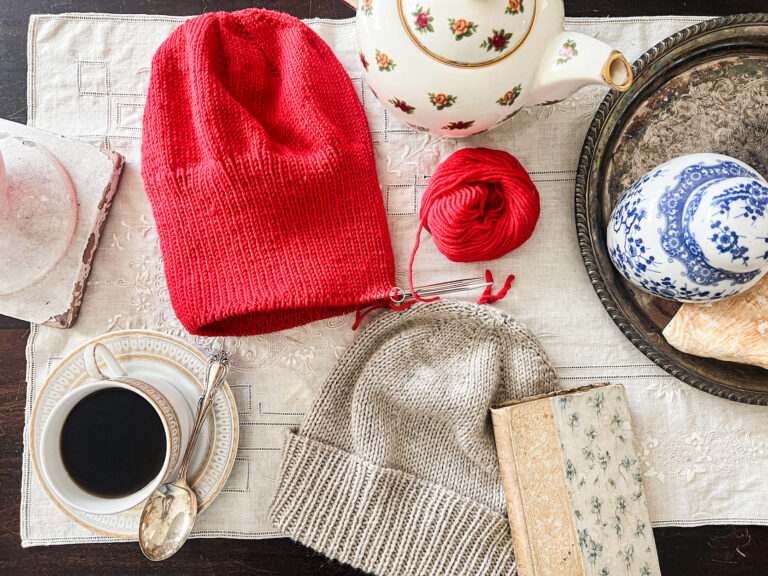
I frequently spend 13-20 hours knitting a pair of socks, even though I could buy a cheap multipack of socks for just $10 or a very nice wool pair for about $30. On the surface, this seems like irrational behavior. Why do we knit things and pour so much time and energy into something that we could easily purchase for less?

But to understand that, you have to understand knitters, and there are a LOT of us. Millions and millions of us. In any group that large, you’ll find a lot of variety.
Knitters are as varied as the many projects they create. Some are funky and loud. Others are soft and dainty. Some swing wildly from one project to the next. Others dedicate themselves to a specific aesthetic or type of item and rarely deviate from past patterns.
Among that wide range of knitters, you’ll also find a wide range of motivations for knitting. I asked friends over on Instagram about what motivates their knitting, and I got a wonderful range of responses. Here are some of the most common ones, along with many of my own motivations for knitting (remember, you can have many reasons for doing something!).
Relaxation
The most common reason I heard from other knitters is that we knit for relaxation. Many knitters experience a flow state while working on their projects, which can be so helpful when we need to unwind and calm down after a long day.
This relaxation element can be particularly helpful when our lives our extremely busy and there is an unavoidable hiccup, like a long wait at the doctor’s office. I used to get so stressed out while waiting, but now I pull out my knitting and slow my breathing to go along with my stitches.
Mental health benefits
Along with the relaxation comments, I also got a lot of notes from knitters who’ve found that knitting helps with their mental health more broadly. There is some research indicating that knitting can help with depression and anxiety (though it’s always good to check with a professional when you can and to consider all the available tools in your mental health toolkit).
Many neurodivergent knitters also find that knitting is a quiet, socially acceptable form of fidgeting or stimming. Anecdotally, I knit while watching my bar exam study videos back in 2010 because I found it helps me focus more easily. I wound up with a shiny new ADHD diagnosis in my late 30s.
Joy of learning a new skill
One of my favorite things about knitting is that no matter how long you’ve been doing it, there’s always something new to learn. Several other knitters mentioned that they love learning new skills with their knitting projects. and they feel a sense of pride and accomplishment when they do so.
For many of us, especially in adulthood, there are precious few places to experience that feeling in a low-stakes way. Knitting gives us a place to try, screw up, rip out our work, and try again until we get it right, all without any real consequences for mistakes.

Connection to past/ancestors
For many knitters, their craft isn’t just something fun they picked up for a hobby. It’s something that was passed down to them when they were a small child, often by much-loved family members. As a result, it’s filled with family history and cultural identity.
The proliferation of heritage knitting techniques and styles underscores the strength of these connections. Whether your roots are in Estonian lace, Fair Isle knitting, or another unique knitting tradition, odds are strong you have a special emotional connection to those techninques.
Even if you’re like me, though, and are the first knitter in your family for a few generations, that connection to the past is still there. I love knowing that when I pick up a set of double-pointed needles and work on a sock, I’m using the same method used by millions of knitters for centuries before me.
Anticapitalism and concerns about fast fashion
Many of us live in capitalist societies, where there is a lot of emphasis on how much value you contribute to your economy and how efficiently you do so. In those circumstances, people often dismiss knitting because it’s inefficient compared to machine-produced items.
But a significant number of knitters finds the relentless pace of capitalism to be exhausting and troubling. In those circumstances, it can feel good, rebellious, comforting, and/or radical to opt out where possible. Making our things by hand is a deliberately inefficient activity in a world that judges a person’s value by their efficiency.
Closely tied to these concerns about capitalism’s effect on everyone living in a capitalist society is a specific subset of concerns about how fast fashion affects the people working in the industry and how it affects the environment. For knitters who are particularly concerned about these issues, knitting their own garments can be a way to remove themselves from the fast fashion cycle.
Desire for unique or high quality items
Fast fashion isn’t the only part of the clothing industry that has frustrated consumers in recent years, though. The overall quality of clothing has gone down. Even brands long-recognized for their quality goods have been skimping on fabric thickness, lining, construction details, and more.
So if you’re someone who really wants a high quality item (like, say, a wool-silk-linen blend with zero synthetics), your best bet might just be to make it yourself.
The same is true for those who want truly unique or unusual clothing, or for those whose style preferences aren’t currently on trend. I spent years knitting myself dainty, lacy things before the neo-Edwardian fashion boom started hitting in the late 2010s because stores just didn’t carry the clothes I wanted to wear (and even today, they’re not necessarily at a price point that works for my budget).

Love of handmade things
Knitters (and makers more generally) know that a handmade item has a certain something about it. There are little imperfections and irregularities that reflect the unique human who made the item. For those of us who cherish human creativity, a handknit garment can feel extra special and even more beautiful.
Handmade clothing signals time, care, and love for the recipient, and this is no less true when the recipient is yourself.
Need for custom clothing to accommodate body shape
Finally, many of us have experienced the frustration of going to stores and finding that the clothes there just aren’t cut with our body shape in mind. To a certain extent, this is just how things shake out when manufacturers have to cover a range of bodies and fit as many of them as possible in as few sizes as possible. There’s that efficiency again, eh?
But none of that makes it feel any better when you can’t find the thing you want in the proportions you need.
So for many knitters, this is also a way to get clothing that fits juuuuuuust right. I know I’ve really enjoyed knitting a sweater for myself and being able to adjust it to fit the spots that garment manufacturers never adjust for.
Let’s stay connected!
Join my newsletter for 30% off all new releases, regular updates with helpful tips and tricks, first crack at registration for upcoming workshops, exclusive discounts, and more.
I’m on YouTube now and would love to have you join me there for regular project updates, technique tips, chats about goings-on in the knitting world, and more.
Prefer to read without ads? Join my Patreon, which starts at just $1 a month!
Join the A Bee In The Bonnet Facebook Group to participate in knitalongs and other fun community events
Come hang out with me on the A Bee In The Bonnet TikTok
Follow along on the A Bee In The Bonnet Instagram
Get inspired via the A Bee In The Bonnet Pinterest