If you hang around people who talk about yarn a lot, you might hear them using the phrase “put-up” to describe the yarn. But what does it mean?

In short, put-up refers to the way that a manufacturer packages yarn into individual units. Sometimes, it also refers to how much yarn is in that unit.
Before we dive into this blog post, though, we need to take the tiniest linguistics detour. Remember, language is not a fixed, static thing. A language that is alive, used and spoken and written, is constantly changing. The same is true for the language we use to describe our craft, especially where that language gets passed from person to person. That means different groups of knitters may use the same word to refer to two different concepts. They also might use different words to refer to the same concept. I’ll point out a couple big points of potential confusion below.
While the confusion can be frustrating, this is not in and of itself a sign that one group of knitters is more authoritative than another (with a significant exception for things like heritage knitting techniques, where terminology is very important and very carefully defined).
Yarn put-up: how the yarn is packaged
Yarn comes in lots of different shapes. You might see yarn in a hank, a skein, a ball, or a cake. This is part of the equation when talking about yarn put-up. It’s referring to how the yarn is packaged.
Here is a picture of a factory-wound ball, also sometimes called a donut:

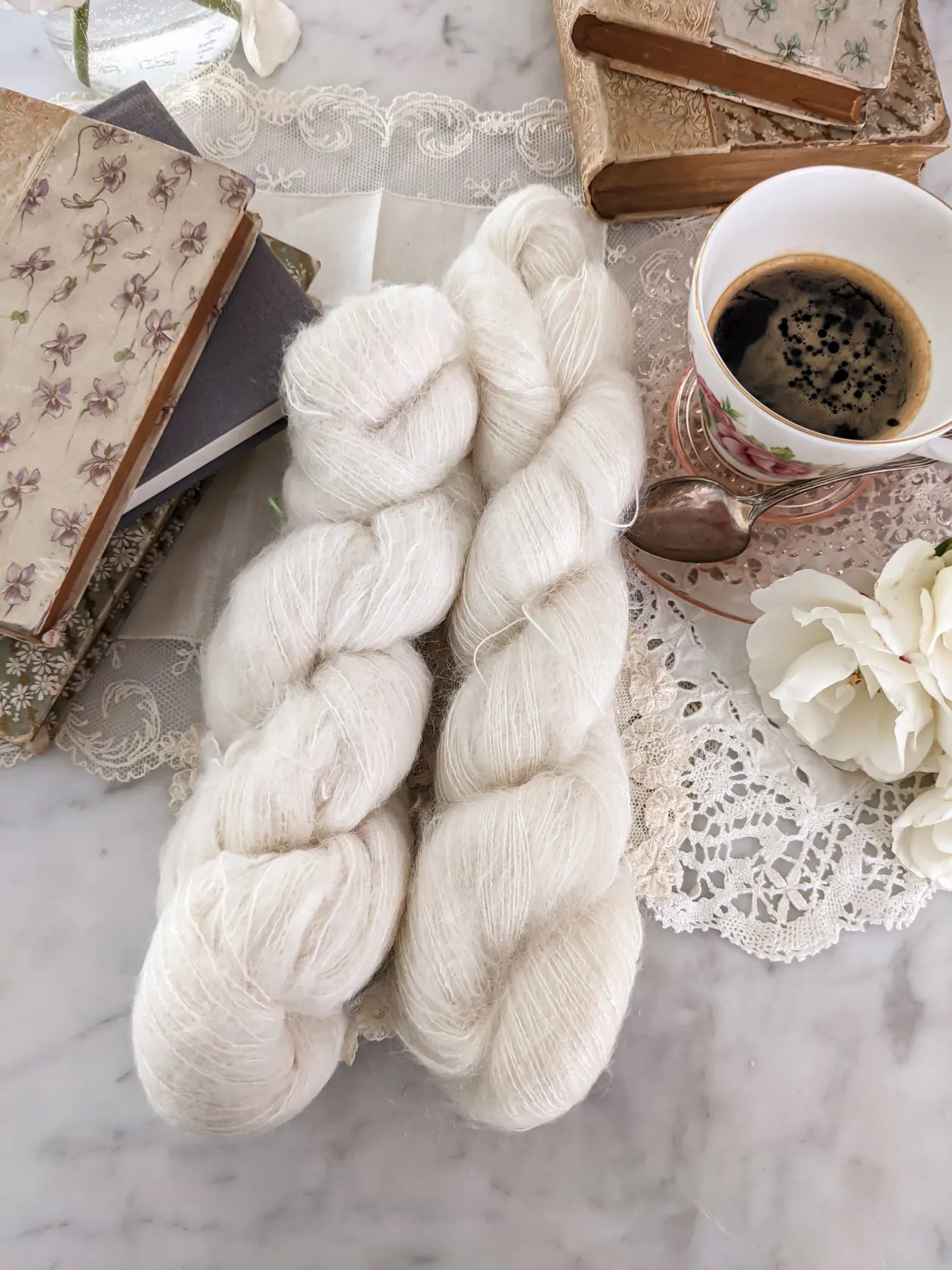
This is a picture of a hank that might also be a skein (see below):

Here is a picture of a skein:

This is a picture of a hand-wound ball that I wound from a hank:

And finally, here is a picture of a cake that I wound from a hank using a yarn winder:

Note that there is some disagreement about whether a hank is also a skein or not. Some sources, like June Hemmons Hiatt’s Principles of Knitting (affiliate link), say that a skein/hank is the same thing: yarn wound into a large circle, twisted on itself, and folded in half with one end tucked inside the other to secure it. Others, like Vogue Knitting’s The Ultimate Knitting Bible (affiliate link), say hanks and skeins are different and distinguish them as I have above. I even saw one blog post from 2010 that said “skein” was just a general word for a unit of yarn.
When it doubt, look closely at the listing photos if you’re buying online.
Why the format of yarn matters
The format of the yarn matters because, depending on how that yarn is bundled up for transportation, there may be extra work on the knitter’s end before that yarn can be used for a project.
Knitters can use a ball or a skein-that-is-not-a-hank just as it is. For both, you can pull yarn from the outside or from the center and knit or crochet directly from that packaging.
If the yarn is wound up into a hank, however, you will need to unwind that yarn and then rewind it into a ball or a cake. Usually, hand-wound yarn will turn into a ball, while yarn wound using a winder will create a cake. If you try to knit directly from the hank, you will just end up with a horribly tangled mess. Do not do this to yourself.
Why is yarn packaged in different formats?
Manufacturers and dyers package yarn in different formats for both functional and aesthetic reasons. Hanks of yarn, for example, are easy to ship and display because of their relatively flat, long shape. Retailers can hang or stack them with little risk that they’ll roll away. The way they’re wound also tends to put minimal strain on the fibers themselves.
Skeins that aren’t hanks can appeal to knitters who want to just grab their yarn and immediately cast on. This yarn format is also easier to stack for display compared to a ball, though a hank is still easier than a skein.
Factory-wound balls are small and compact, so they’re great for projects where the knitter only needs a little yarn. Knitters might also choose them when working on a project that needs to be portable. That way, you only have to carry a little yarn at a time.
Each of these formats might also be the ideal choice for showing off a particular yarn’s unique colors. Subtle stripes might show up best in a skein, while bold color-blocking would look best twisted up into a hank.
Is it put-up or something else? Yardage to weight ratio
Sometimes, you’ll see knitters using the term “put-up” to refer to how many yards there are in the package of yarn and how much that package of yarn weighs. Other sources, like this article from Modern Daily Knitting, refer to that concept specifically as “grist.”
Whatever you call it, this information is really important for a knitter. It can help you get a sense of how thick/dense that yarn might be. Usually, if yarn has high yardage and low weight, you can be pretty sure it’s on the finer side. Conversely, if there are not many yards in a larger weight of yarn, you can be pretty sure that the yarn is on the thicker side.
Manufacturers most frequently package yarns in units of 25 g, 50 g, and 100 g. Sometimes you will see bundles of mini skeins with 10 g or 20 g per mini skein. Occasionally, you will see extra large hanks of yarn with 200 g or more, but this is not common. If you are working in very large quantities of yarn, you may buy the yarn on a cone. That will give you many, many yards and several hundred grams.

How yarn put-up affects yarn substitution when knitting
So, why does this matter? Well, when you are substituting yarn (using yarn for a pattern that is not the same yarn used by the designer for their original sample), having a good sense of the original yarn’s put-up/grist and your substitute yarn’s put-up/grist is the first step toward figuring out whether your substitute yarn will be a good substitute yarn.
For example, let’s say the original yarn used by the designer has 300 yards per 100 g. If the yarn you would like to use has 310 yards per 100 g, that’s a good sign. It’s not a guarantee that it’ll be a good yarn substitution, but it checks a major box. If, on the other hand, the yarn you want to use has 150 yards per 300 g, that’s a very bad sign. That pretty much guarantees the yarn will be much too thick. You should try looking for something with a put-up/grist that is a little closer to the designer’s original sample yarn.
Understanding yarn put-up also helps you substitute yarn where the two different yarns come in different quantities. For example, let’s say the pattern uses a yarn with 300 yards per 100g hank. You have a yarn that you think would be a good substitute, but it come in balls of 150 yards per 50g.
Now, if you didn’t understand yarn put-up, you might think that those are two totally different yarns. If you understand yarn put-up, you know that these are actually probably very similar yarns. That’s because two 50g balls of 150 yards each is the same as one 100g hank of 300 yards. If you substitute with the yarn sold in 50g balls, you just need to know how many yards you need. That will tell you how many balls to buy.

How yarn put-up affects the design process
Understanding yarn put-up is important not only for substituting yarn, but for knitting your own designs. If you want to eyeball something and wing it a little bit, it helps to have a sense of how much yarn you might need.
For example, let’s say you want to knit yourself a DK-weight sweater, and you know that most of the time, you use about 1100 yards of DK-weight yarn to knit yourself a sweater. If you are knitting a similar style and size of sweater compared to your previous sweaters, you know that you will likely need around 1100 yards of DK-weight yarn again. Knowing how many yards are in each unit of DK-weight yarn you’re thinking of buying will help you make sure that you are buying the right amount of yarn.
This is also why, as a designer, I never just put in my pattern that you should use, for example, three balls of XYZ yarn brand. That’s because that’s not terribly specific and doesn’t help you much with your yarn substitution.
If there are 300 yards per 100g in each hank of yarn, and I tell you to use three hanks, do you need 900 yards or do you need 650 yards? Depending on the answer, you might only need to buy three hanks of a substitute yarn. You also might need to buy four, five, or even six hanks of a substitute yarn, depending on that yarn’s put-up.
Let’s stay connected!
Join my newsletter for 30% off all new releases, regular updates with helpful tips and tricks, first crack at registration for upcoming workshops, exclusive discounts, and more.
I’m on YouTube now and would love to have you join me there for regular project updates, technique tips, chats about goings-on in the knitting world, and more.
Prefer to read without ads? Join my Patreon, which starts at just $1 a month!
Join the A Bee In The Bonnet Facebook Group to participate in knitalongs and other fun community events
Come hang out with me on the A Bee In The Bonnet TikTok
Follow along on the A Bee In The Bonnet Instagram
Get inspired via the A Bee In The Bonnet Pinterest



I wish that manufacturers that sell their yarn in skeins would mark on the band which end to pull from. I always have a 50/50 chance of ending up with yarn vomit.
I always pull the outer edge to avoid yarn vomit issues! I know some people don’t like that bc then the ball/skein moves around more, but it’s worth it for me.