There was recently another dust up in the fiber arts world involving allegations of design copying between two different knitting designers. While I don’t have any thoughts on that particular situation because I don’t know any of the parties involved and I’ve never made either of the patterns, I thought this would be a good jumping-off point to talk about design similarities, copying, and outright repurposing someone else’s pattern.

Before we go any further, I need to make something very clear here because I am a former lawyer with an inactive bar license. Absolutely none of this is legal advice. None of it. If you have concerns about the legality of any particular pattern copyright issue, you should definitely consult with a legal professional who is licensed to practice law in the relevant jurisdiction for your question. Sorry for the disclaimers, but I’d rather avoid any mixups
So we’re going to skip questions of whether something is legal in this post. Instead, we’re going to ask ourselves how the knitting community perceives various scenarios as a matter of ethics and community norms/expectations.
Pattern Theft vs. Design Copying
There are different ways that a designer’s pattern might be taken and used in a way that the designer objects to. One is outright pattern theft, where the pattern is taken from one source and offered elsewhere in the exact same format with no changes.
For example, if somebody downloaded one of my patterns from Ravelry, took the PDF that I had created, and then posted that PDF elsewhere on a site either for sale or for free, that would be something I would object to. This is a relatively straightforward issue that the majority of people in the fiber arts community agree is ethically wrong.
There might be an exception where the pattern is so old that it is out of copyright. Again, the nuances of whether and when copyright expires can be complex, so you shouldn’t just assume that because something is old, it’s no longer protected by copyright. In fact, because this can be a fairly involved inquiry, posting somebody else’s pattern is just not something I would be comfortable doing.
Now, where things get more interesting is the question of whether two patterns by two different designers that lead to similar or identical results are a problem. Again, we are going to be speaking in terms of ethics and community norms here, not legalities.

Harmless Reasons for Design Similarities
There are so many harmless reasons that two designers might have very similar patterns. In fact, this is such a common occurrence that when I see two similar patterns, my default assumption is that some funny coincidence has happened, not that one of them copied the other. Here are some examples of scenarios that I have seen happen before.
Scenario one: two designers are creating a very basic pattern for a very basic knit
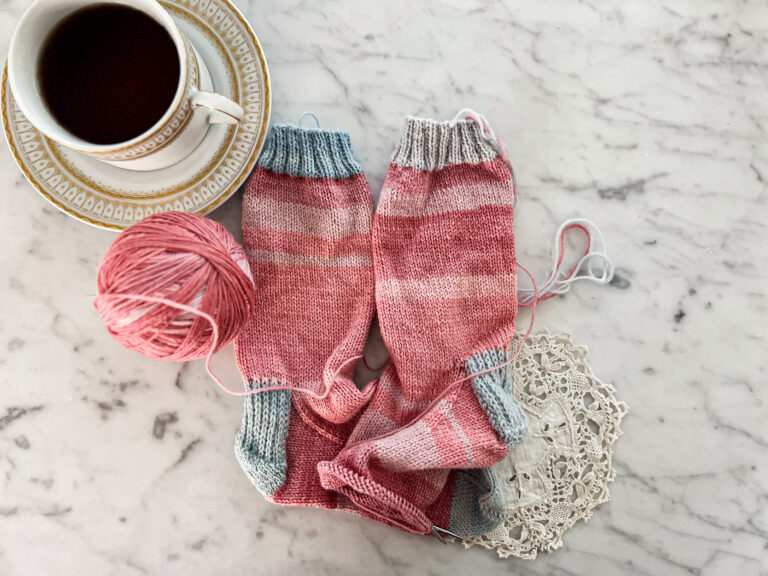
Let’s take sock designs for an example, because I love designing socks. Socks have pretty standard shapes. You have your cuff, your leg, your heel, your foot, and your toe. While there are some innovations regarding the construction of some of those parts, the basic shape of the sock is the same.
If I create a pattern for a vanilla sock, and another designer also creates a pattern for a vanilla sock, odds are pretty good that those socks are going to be very similar if not identical. That’s because there are only so many ways to shape each of the components of a sock, and a vanilla sock has nothing in the texture to distinguish it from other socks.
The same goes for very simple beanies, sweaters, and scarves. If you’re designing a garter stitch scarf, I can guarantee you there are an awful lot of patterns out there that are going to look just like your garter stitch scarf. That’s not because you’ve copied someone and it’s not because someone else copied you.

Scenario two: the designers are both trying to re-create the same source item
This scenario is particularly common among knitters trying to re-create historical garments, but it can also happen among designers trying to re-create garments that they’ve seen in movies or TV shows. My favorite example of this is Eleanor of Toledo‘s burial stockings.
Eleanor of Toledo was the grand Duchess of Tuscany in the 1500s, and when she died, she was buried in an exquisite pair of delicately knit silk stockings. These stockings have been extensively photographed, but very few people have access to the physical stockings themselves. Cosplayers and historical knitters, though, rightly would love to knit a pair of these stockings for themselves.
It will probably not surprise you to learn that there is not a known knitting pattern from the 1500s for her stockings. As a result, several different knitters over the years have looked closely at the photographs of these stockings and have done their best to reverse engineer a pattern for them from the pictures. There are now a few different patterns that you can choose from.
Now, these patterns are all going to give you very similar results, but that’s because they’re all starting from the same source material. None of them is copying the other. They’re all copying someone from 500 years ago.
Scenario three: the designers are drawing inspiration from the same non-knitting source
I have actually had this happen to me before, and it was really funny. A few years back, I was getting ready to release my Pyrifera Socks, which feature panels of lacy leaves going down the front and back of the sock.
As I was wrapping up the testing on that sock, my friend Aimee Sher posted a picture of their own pair of socks they would be releasing soon. Guess what? The socks had center lace panels of leaves.
Now, Aimee and I are friends, so this was an easy situation to address. I messaged Aimee and said “So, this is funny…” And sent a picture of the socks I had been working on.
We had a good laugh, talked about whether we thought it would be an issue in terms of confusing buyers or making people think that one of us had copied the other, and decided it was no big deal. If anybody raised the issue, we could let them know that we had already talked about it, and we were fine with it.
Ultimately, we realized that we were drawing inspiration from the same places. We both like knitting socks with lacy textures. It was spring time, so we were both thinking pastels and fresh leaves. These things happen.

Scenario four: the designers are working from the same stitch dictionary
It’s not uncommon to find designers using stitch patterns they have both sourced from the same stitch dictionary. While I generally don’t like to use the exact stitch pattern, even where I’ve made changes, there’s still similarities with the original stitch pattern. If the stitch pattern is very simple, then there’s really only so much you can change. If another designer is working from that same stitch dictionary, our projects are going to end up looking similar.
Ultimately, there are only so many ways to combine stitches and make wearable items. While there are the occasional knitting pattern designers doing truly revolutionary things like Woolly Wormhead with their hat patterns or the late Cat Bordhi with her sock patterns, most of us are not really breaking new ground with our designs here. As a result, most of the time, design similarities are more likely to be the result of a funny coincidence than any intentional copying.
What I Do When I Suspect Copying
These sorts of innocent coincidences happen pretty regularly. As a result, I’ve come up with a few conclusions for myself and how I conduct my business. You may share these conclusions or reach different ones for yourself. That’s okay. But here’s where I come down on these things.
No action without definite proof
Unless I have concrete proof that somebody has copied one of my patterns to a meaningful extent, I think it’s probably best to let things slide. By all means, gripe to some friends or colleagues or family members, but a public dustup is probably not going to be helpful.
Nobody can undercut me without my permission
Speaking for myself and my business, I take the approach that if another designer is able to come up behind me, make a pattern really similar to one of mine that already exists, and make a significant dent in my sales because people want their pattern instead, that’s on me. I should have marketed my pattern better. It should be to the point that, if somebody releases a pattern similar to mine, anybody who would want that pattern has already bought my version of it.
No picking on smaller designers
Over the years, I have seen a few cases of large designers calling out smaller designers for alleged copying. In almost every single one of those cases, I didn’t think the designs were similar enough for it to matter. Know what I do remember, though? I remember that I saw a person with a lot of power in the industry picking on a smaller person with a smaller audience and less power, and it left a bad taste in my mouth. It’s not a good look.

How I Minimize the Risk of Copying Concerns
I see new designers every now and then who are so worried about accidentally designing something similar to another, existing pattern. Without getting into the legalities of intent, most knitters understand as a matter of community norms that accidents and coincidences happen. The community will respond much differently to those scenarios vs. situations that really look like out-and-out copying.
As for myself, I don’t tend to follow very many of my fellow designers on social media because I don’t want to be too heavily influenced by what they’re doing. It’s fun to cheer for friends and encourage each other, but when it comes to inspiration, I try to look elsewhere—Renaissance art, rococo interiors, Edwardian fashion, Art Nouveau jewelry. Then I can truthfully point to my source of inspiration and explain how I interpreted it for my own project.
Designers Care About Reputations
One last thought before I sign off for the day. In my years of designing knitting patterns, I’ve had the chance to chat with a LOT of fellow designers. We’re talking hundreds of them at this point. One of the common threads I see running through each of our businesses is that we care deeply about running them well, and that includes maintaining a good reputation.
The easiest way to torpedo an otherwise sterling reputation would be to get caught intentionally copying another designer’s pattern too closely. See, I’ve survived years of internet conflict, and I’ve learned that knitters have memories. Loooooooong memories. Some even keep receipts.
Now, this doesn’t mean that there aren’t bad actors out there. The AI slop generators should be looked at with especially close scrutiny, and of course there are lazy or uninformed designers who are just out to make a quick buck or who don’t know the rules. If it’s a reasonably well established designer, though, I’d bet dollars to donuts that they know the reputational risks involved in copying and just don’t want to get anywhere near it.
Let’s stay connected!
Join my newsletter for 30% off all new releases, regular updates with helpful tips and tricks, first crack at registration for upcoming workshops, exclusive discounts, and more.
I’m on YouTube now and would love to have you join me there for regular project updates, technique tips, chats about goings-on in the knitting world, and more.
Prefer to read without ads? Join my Patreon, which starts at just $1 a month!
Join the A Bee In The Bonnet Facebook Group to participate in knitalongs and other fun community events
Come hang out with me on the A Bee In The Bonnet TikTok
Follow along on the A Bee In The Bonnet Instagram
Get inspired via the A Bee In The Bonnet Pinterest


This is a great post. Thank you, Lauren.
I’m glad you enjoyed it!