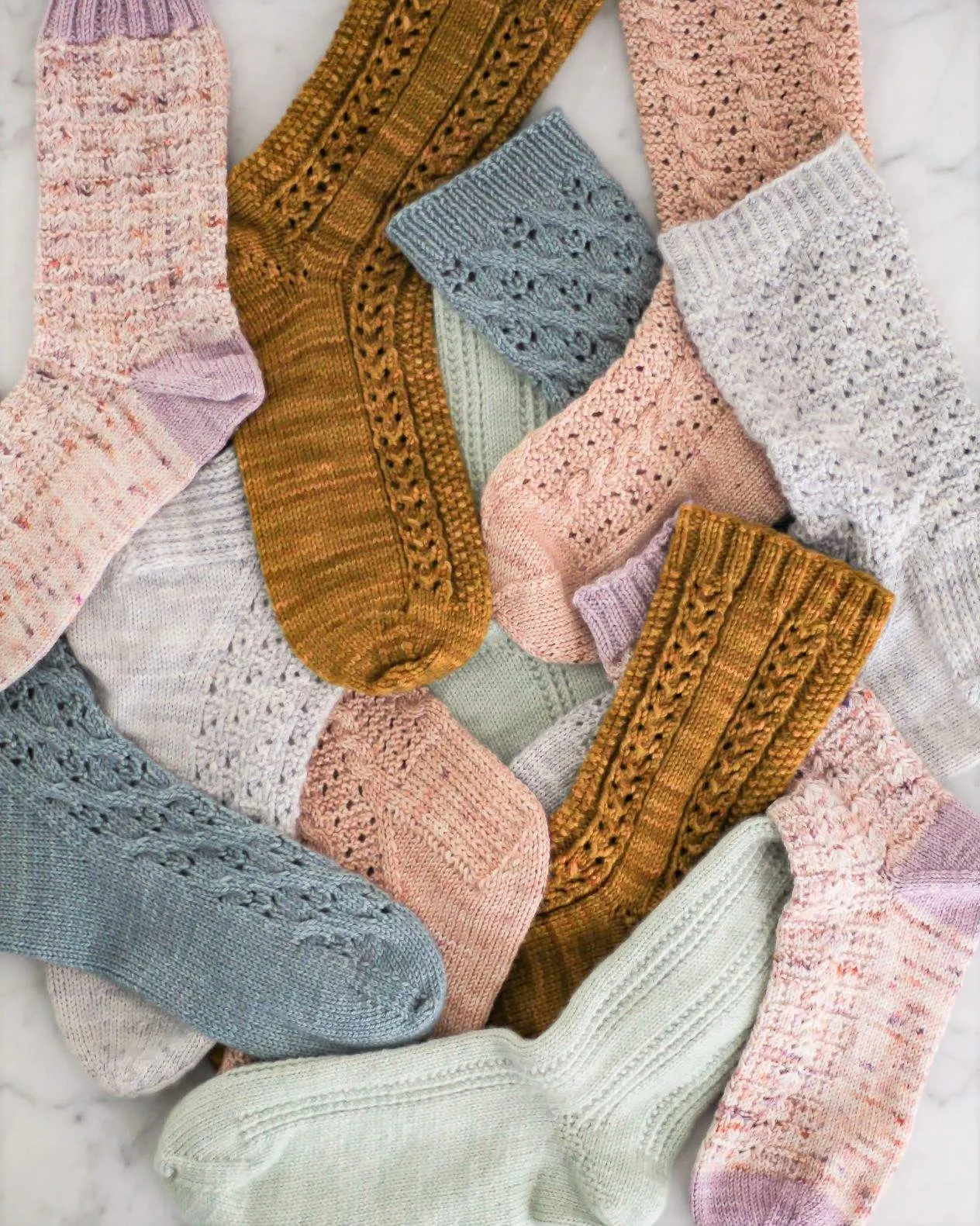
Second sock syndrome plagues many a knitter. It’s a phenomenon where the knitter will happily finish the first sock and then, for one reason or another, struggles or even fails to finish the second.

Second sock syndrome isn’t a personal failing, and it’s definitely not a sign that you’re lazy. Usually, it means there’s something else going on beneath the surface.
In today’s blog post, we’ll look at some of the common causes of second sock syndrome and then explore some ways to reduce or even cure it.
What Causes Second Sock Syndrome?
In my experience, second sock syndrome is usually caused by one of three things: a sock knitting method that doesn’t work well for the knitter, a sock pattern that doesn’t suit the knitter, or lost enthusiasm for repetitive tasks.
A suboptimal sock knitting method was the cause of my second sock syndrome. Years ago, I knit my socks on DPNs, and I frequently struggled to finish a full pair. I only knit maybe 5 pairs of socks during my first ten years of knitting, if you can believe it. Then I discovered small circular needles, and my second sock syndrome was almost entirely cured.
The second problem could be the sock pattern. I still sometimes struggle to finish a pair where the pattern is either too simple or too complex. If it’s too simple, I get bored. If it’s too complex, I get overwhelmed. Both lead to me struggling with the second sock.
Finally, I’ve seen a lot of knitters struggle with feeling like the second sock is boring because it’s just a repetition of the first. If this is you, I have some ideas below.
Now that we’ve covered the common causes of second sock syndrome, let’s look at some tips for managing it.

Tip 1: Cast On the Second Sock Immediately
This might seem kind of obvious, but I think a lot of us really underestimate the power of momentum. If you stop after the first sock and do anything other than casting on for the second sock, that momentum is broken.
Do not cast on a nice palate cleanser hat. Do not finish another lingering project. Don’t even think about taking a break and coming back to the socks in a week.
Cast on for the next sock as soon as you finish up the first one. You don’t have to finish the second sock right away. But the momentum of starting that second sock is going to overcome a significant mental obstacle that gets in the way for a lot of us.
Tip 2: Keep Detailed Notes
This tip is for the people who, for whatever reason, didn’t listen to tip number one. If you’re going to take a break between your two socks, make sure that you have kept good notes.
That means that if you made any deviations from the pattern whatsoever, you need to have written that down somewhere. The last thing you want to do is to have to sit there with your first finished sock, trying to count the number of decreases you worked on the gusset or how many repeats you worked until you started the toe.
Keeping good notes as you work can save you grief down the line. I still wouldn’t recommend a lengthy break between the two socks because you could end up with significantly different gauge, but good notes will help prevent some of these other common problems.

Tip 3: Use Stitch Markers as Progress Milestones
Different people struggle with different parts of the sock. If you’re one of those people who finds the leg or the foot interminably slow, using progress keepers to show how much work you’ve actually accomplished during each knitting session can be really motivating.
Try inserting a progress keeper at the end of each day’s knitting session. Then, instead of one large block of stockinette, you have tangible proof of how much you have accomplished each time you sat down to knit. You’ll no longer have the problem of feeling like you have been knitting for ages and haven’t made any progress. Instead, you can actually see the progress.
Tip 4: Reward Yourself Along the Way
I may be an adult, but listen, I’m not above bribing myself with M&Ms.
If you’re really struggling to get through that second sock, pick up a packet of your favorite treats, and then make a list of milestones on the sock. Maybe you get a little treat each time you finish a full repeat of the leg. Maybe you get large amounts of treats after you finish a whole section of the sock like the leg or the heel turn.
Whatever it may be, you’ll have something to look forward to, and that can be powerful motivation.

Tip 5: Consider Two-at-a-Time Socks
For those knitters who really can’t stand the prospect of knitting a second version of the thing they just finished knitting, two-at-a-time sock knitting might be the solution for you.
The most common way to do this is two at a time on magic loop, and the most common version of that is toe-up. You can absolutely knit cuff-down socks two-at-a-time on magic loop, though. I’ve done it.
There is also a method where you knit one sock inside the other using a similar knitting technique to double knitting. This is not something I have mastered myself, but I would like to give it a try sometime soon.
Tip 6: Choose Yarn That Keeps You Interested
If you’re knitting a very simple stitch pattern that isn’t enough to hold your interest on its own, sometimes, you can trigger interest by using a fun yarn, like one that is self-striping. That way, you get a little jolt of excitement as the new color starts and you get to see what stripe is coming up next in the sock.
Fun yarn can be a great way to add some entertainment to an otherwise tedious project.

Tip 7: Try a Different Sock Knitting Method
I mentioned at the start of this post that I used to struggle with second sock syndrome until I discovered tiny circular needles. If you are also struggling with second sock syndrome, the problem might actually be the knitting method that you are using.
Luckily, there are tons of ways to knit socks. You can try DPN‘s, small circular needles, magic loop, two circular needles, or any one of a number of other ways to knit socks. If one of those doesn’t work, try a different one, because there’s gotta be something out there that’ll feel good.
Tip 8: Choose a Sock Pattern in the Sweet Spot
Some knitters love knitting simple stockinette projects. Other knitters crave deeply complex patterns. Maybe you love cables or color work. Perhaps you’re a knitter like me, who needs a pattern that’s interesting enough to keep them engaged but not so difficult that it gets overwhelming.
Whatever your sweet spot is, try to choose sock patterns in that sweet spot. It will keep you engaged and happy, and you’ll be much less likely to give up. If you try out a pattern and it turns out to not be in your sweet spot, it’s okay to frog and try something else.

Conclusion
Remember, second sock syndrome is really common, and you’re not alone if you’re struggling! But these tips should help you get things sorted. You’ll be on your way to cozy toes in no time.
Let’s stay connected!
Join my newsletter for 30% off all new releases, regular updates with helpful tips and tricks, first crack at registration for upcoming workshops, exclusive discounts, and more.
I’m on YouTube now and would love to have you join me there for regular project updates, technique tips, chats about goings-on in the knitting world, and more.
Prefer to read without ads? Join my Patreon, which starts at just $1 a month!
Join the A Bee In The Bonnet Facebook Group to participate in knitalongs and other fun community events
Come hang out with me on the A Bee In The Bonnet TikTok
Follow along on the A Bee In The Bonnet Instagram
Get inspired via the A Bee In The Bonnet Pinterest




I think this is the best knitting article I have ever read. And I’ve been dating for over 50 years. So there!
You have listed every single one of the issues I encounter with my bloody second sock! At least when I could knit and I’m looking forward to being able to again.
🩷🩷
I dont knit two at a time, but I work on both socks simultaneously on separate needles. I knit one cuff, then the other. I knit one heel, then the other. I knit one foot, then the other. I knit one toe, then the other. The down side with this approach is that if I dislike the sock and want to rip it out, I have to rip out two socks in progress.
Ashli – I’m so glad you posted this! When I knit my first pair of socks years ago, I knew myself well enough to buy two sets of DPNs. Now I pull yarn from the center of the ball for one sock and knit the other sock from the outside of the ball using the same method you described.