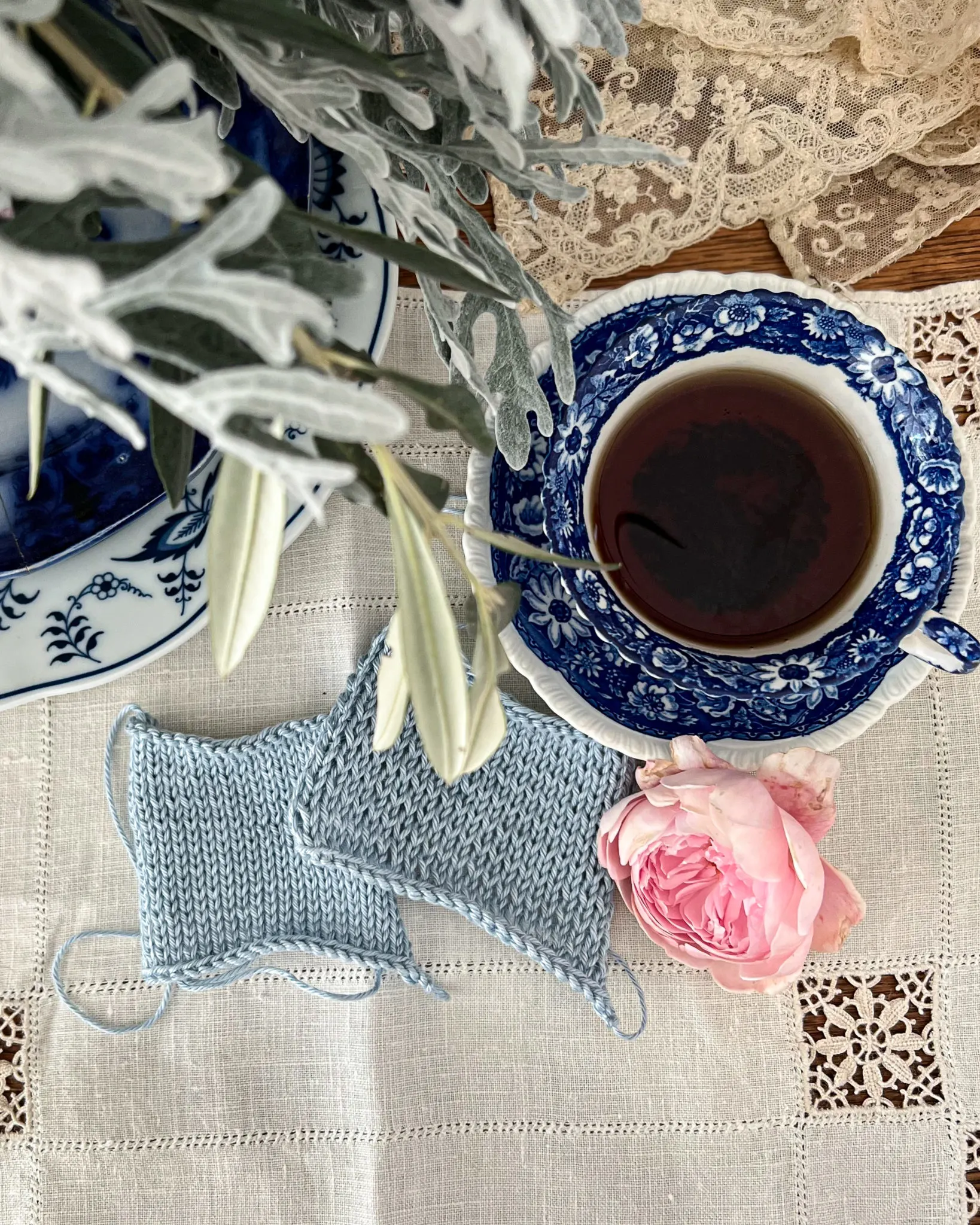
Knitters joke a lot about frogging, but frogging your knitting can actually be a fraught process. In today’s blog post, we’re going to take a look at why knitters frog, when it makes sense to do so, and when you might want to hold off.

What is Frogging?
Frogging is one of those silly knitting vocabulary words that comes from a pun. When you take your work off your needles and undo it by pulling the working yarn, you are ripping it out. What else says “rip it, rip it?” or perhaps, “ribbit, ribbit?” A frog.
If I’m honest, it makes me giggle every time. I do love a silly pun.
To succinctly sum things up, frogging is when a knitter rips back their work, either partially or all the way. Usually, in discussions like this, we think of it as ripping your work all the way back to the starting point. For purposes of today’s blog post, that’s the definition we’re going to use.
When should you frog a project?
So now let’s talk about when you might want to frog a project, that is, rip it all the way out to the beginning and either start over or use the yarn for a different project. There are a lot of reasons you might decide to do so.
Fit problems
The first and most obvious reason you might want to frog a project is that you have realized it’s going to be much too big or much too small for you, and you really want that finished knit to wear yourself. If that’s the case, there’s nothing for it but to start over.
While there are some things that can be done to address very minor fit issues, usually through the blocking process, if you have a major fit issue, you can’t really do much. Frogging and choosing a different size, a different needle, or a different yarn will be your next step.
Yarn colors aren’t pooling/distributing well
This is a challenge that happens a lot with hand dyed yarn, especially hand dyed yarn with heavy variegation. The color variegation in that yarn is going to cluster together differently depending on the circumference of the item that you are knitting.
If you knit a sweater that has a 32 inch circumference, for example, the color repeats in the yarn are going to line up at different places in the sweater compared to a 42 inch sweater or a 52 inch sweater. That’s because the colors are placed at the same point on the yarn, but the yarn has larger or smaller circumferences around which to repeat.
If you realize as you’re knitting that the colors are clumping together in a way that you don’t like, the only way to really fix that is to frog it and start over again. When you start again, try alternating balls of yarn every few rows to break up the color pooling.

It’s boring
Life is too short to spend our leisure time doing things that bore us. If you are chronically, terminally bored with a knitting project, you do not have to suffer through it. It’s okay to frog that project and do something else with the yarn.
You’ve made a big mistake
A lot of mistakes can be fixed by dropping back a few rows and correcting the stitches. Some mistakes, though, can’t.
For example, if you are working a raglan sweater and you are past the sleeve divide when you realize that you only worked 75% of the increases you needed to work, that’s not something that can be fixed by dropping back and adding or removing a few stitches. You’re going to have to frog at least part of the way back.
Yarn and pattern aren’t a good match
Sometimes the yarn looks really beautiful in the hank, and even when it’s wound up into a cake, but once you start knitting with it, you realize it’s just not the right yarn for the pattern you’ve chosen.
Maybe it’s a really fuzzy yarn and you are working on a lace project or a project that needs lots of stitch definition. Maybe it’s a variegated yarn that looked subtle enough in the skein but turns out to be too busy for the stitch pattern in your project.
Whatever the reason, if the yarn and the project are just a fundamental mismatch, the best solution is to frog and find either a different yarn or a different project.
Yarn quantity problems
The last common reason to frog is that you realize partway through the project that you will not have enough yarn and you can’t get more to finish the project.
I’m not talking about situations where you’re short by a dozen yards and you need to bind off the sweater hem a few rounds early. We’re talking being short by a few hundred yards and not being able to make the knit item work otherwise.
If that’s the case, it’s best to frog and buy a different yarn for that project and or find a different project for your existing yarn.
Before starting the next project, it’s best to weigh all of the yarn you have for it and make sure that you have as much yarn as the labels say you’ll have. Sometimes, a ball or skein of yarn can be up to 10% over or under the label quantity.

When should you keep going?
Now, there may be times where you want to frog a project, but there are reasons you should think about pushing through that impulse and finishing the project anyway. Here are some.
Fit issues
Now, I know I mentioned fit issues above, but I’m talking about different fit issues here. If the fit is just a little bit off, and you’re working in a natural fiber that you know will probably grow when you get it wet, odds are good that the blocking process will help those sleeves reach the length that you need them to be. You won’t even have to do any stretching.
Another option, if you have really significant fit issues to the point that the garment will not fit you, is to give it to somebody in your life who will fit the item and you know will enjoy using it. I see this a lot in knitting groups. online. People finish a project, find it doesn’t fit them, and give it to a sibling or a friend or a grandkid. If you have somebody in your life who will like the finished item, and you don’t mind not having the finished item to wear yourself, carry-on.
You’ve made a small mistake
It’s really common for newer in particular to realize they’ve made a small mistake, panic, and rip out the entire project. You do not need to do that.
In fact, most small mistakes can be fixed by taking just a couple stitches off your needle, dropping back, reworking, that stitch, and then laddering back. This isn’t necessarily the most intuitive option, but it is a skill that is learnable, and it will make your life so much easier once you know how to do it.
In the alternative, you can also just decide to ignore the mistake if it’s a small one. You do not need to frog. I repeat. Do not frog.

It’s boring
Yep, I did it again. Although a boring project can be a valid reason to frog it, sometimes projects are just temporarily boring. I find this happens a lot to me on garments once I get to the body section. In fact, I will drag my feet to avoid knitting around and around in circles doing the same thing over and over again.
I don’t usually frog those projects, though, because I want the finished knit badly enough. If that’s the case for you, too, keep going.
You’re judging it too early
Sometimes, in the middle of a project, we start getting a sinking feeling in the pit of our stomach. It doesn’t look right. It doesn’t feel right.
But often, this is just us getting up in our own heads. It’s hard to tell halfway through a project whether the finished knit it’s going to be good or bad. Especially if you’re knitting with natural fibers, the unblocked WIP might bear very little resemblance to the blocked, finished item. Don’t panic.
You’re frustrated right now
Frustration with knitting projects is really common and totally normal. I find it hits me most strongly at night, when I’m tired and keep making silly little mistakes. If that happens to you, don’t frog it just yet. Your project may just need to spend a little time in timeout.
Speaking of which, let’s talk about when to put a project in timeout before you decide whether to keep it or frog it.

When to put it in time out before you decide:
I’m a big fan of putting my knitting projects in timeout. Sometimes I do it because I’m annoyed with them for some reason. Other times, I do it because the project is just not a great option for the time of year or the circumstances in which I’m knitting. Sometimes I do it because the project requires a lot of concentration and my brain is not in a place to give that level of concentration.
Let’s talk about some other reasons you might frog your project.
You made a mistake and you’re not sure you can fix it
It’s really common to make a mistake in your knitting and feel like you do not have the skills to fix that mistake. The good thing is, knitting is wonderfully learnable. No matter what the mistake is, if it’s fixable, I can almost guarantee you there is a YouTube video showing you how to do it.
If you’ve made a mistake, but you love the project otherwise, do a little research before frogging. You might find that you can fix the problem pretty easily.

There’s a new technique that’s frustrating you
Sometimes, when you’re tackling a project that is slightly above your skill level, you’ll encounter a new technique that is frustrating you. After years as a teacher, I can pretty much promise you that a frustrated brain is much harder to work with and learn with than a brain that has had a break.
If the project you’re working on is just frustrating you too much, it’s okay to take a break and work on something else. You can also practice that technique on a swatch to get the hang of it before you go back to the larger project. Give yourself time and space to learn and practice the technique before you decide to rip out the whole project.
You’re burned out on the project but still want the finished object
This happened to me several times while I was working on the Mitered Square Blanket of Doom. Part of the reason it took three years was because it was a really big project. Another part of the reason it took three years is that I took several breaks of a few months each. It was a very large, very repetitive knitting project, and there were times when I just didn’t want to work on it anymore.
If you find yourself in the same place with your knitting project, that is totally OK. Instead of frogging it, though, let it sit for a bit, first. If you come back to it after a while, and you still hate looking at it, then go ahead and frog.

A note about the sunk cost fallacy
When you are making your decision about whether to frog a project or not, be careful not to fall victim to the sunk cost fallacy. This is a logical reasoning error where you conclude that because you’ve already spent time, money, and or energy on something, you have to finish it. That’s not true at all.
That’s why I encourage knitters to ask themselves other questions when they are trying to figure out whether to frog the project. Will it fit? Do they still like the finished object that will result from their work? Are they just momentarily bored, or do they actually dislike working on the project and no amount of time or distance will change that?
Ultimately, the decision to frog has very little to do with the time and effort you’ve already expended on the project and everything to do with how you want to spend your future time and effort. With very few exceptions, The yarn can be reused, so there’s no loss there. This is about you and how you want to spend your future knitting time.
Using Lifelines to Make Frogging Easier
Finally, if you are working on a project and you suspect you may need to frog just part of it in the future, consider using a lifeline. Lifelines will make it easier to frog back to a specific point in the project without having to frog the entire project. I’ve got a blog post on how to insert a lifeline that will make this an easier process for you.
Let’s stay connected!
Join my newsletter for 30% off all new releases, regular updates with helpful tips and tricks, first crack at registration for upcoming workshops, exclusive discounts, and more.
I’m on YouTube now and would love to have you join me there for regular project updates, technique tips, chats about goings-on in the knitting world, and more.
Prefer to read without ads? Join my Patreon, which starts at just $1 a month!
Join the A Bee In The Bonnet Facebook Group to participate in knitalongs and other fun community events
Come hang out with me on the A Bee In The Bonnet TikTok
Follow along on the A Bee In The Bonnet Instagram
Get inspired via the A Bee In The Bonnet Pinterest