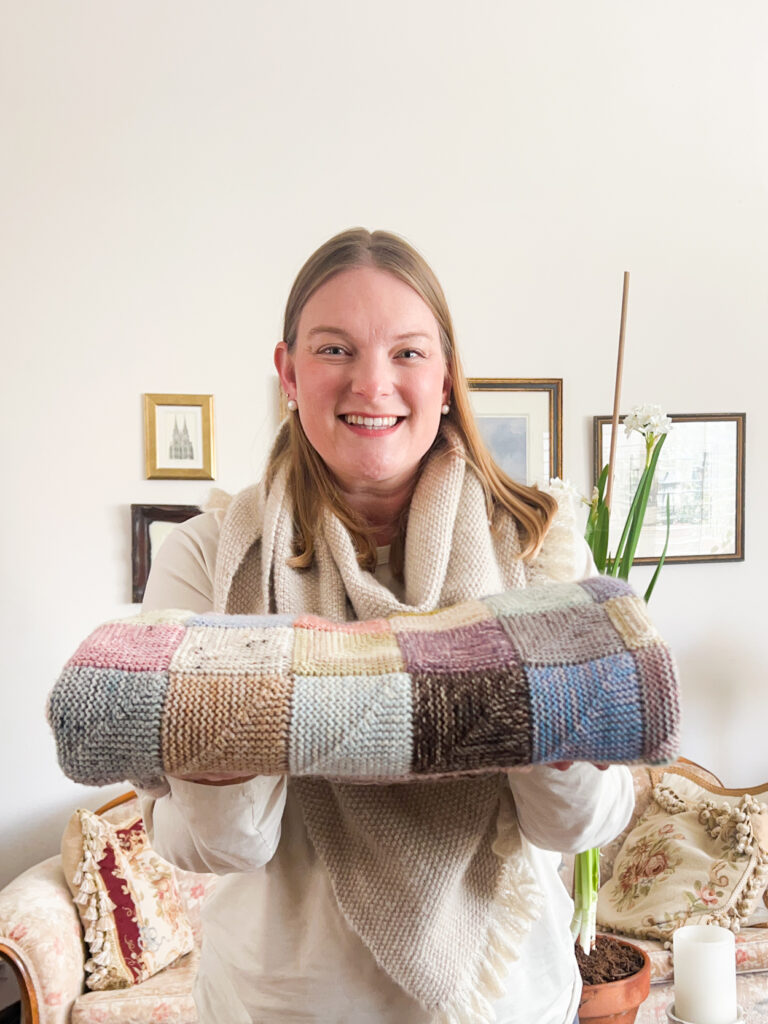
After three years, the Mitered Square Blanket of Doom is finally finished! Over those years, I’ve gotten a lot of questions about it, and those questions tend to fall into a few categories.

So in today’s blog post, I’m going to answer as many of them as I can. I will be sharing a lot of numbers, details, and reflections about this blanket. If you are interested in knitting your own mitered square blanket, I do have a free tutorial on my blog that walks you through the process step by step.
The Numbers
This blanket is made up of 273 individual mitered squares. Each square took approximately 45 minutes to knit. Some were faster, some were slower, but that average puts the total knitting time at roughly 205 hours.
On top of that, there was the matter of weaving in ends. I did not leave all of that for the end, but I wasn’t exactly diligent about weaving them in as I went, either. Instead, I let the ends build up for three or four rows at a time and then wove in a large batch all at once. I timed how long it took to weave in one set of ends and multiplied that by the total number of ends in the blanket. That added approximately 8.6 hours.
Altogether, this blanket contains somewhere around 214 hours of knitting and finishing work.
Yarn Weight, Yardage, and Cost
The blanket uses approximately 1,800 grams of yarn, which is about four pounds. That works out to roughly 18 skeins of fingering weight yarn. I held the yarn double throughout the project, which I will talk more about in a moment.
Almost all of the yarn is indie hand-dyed sock yarn, and nearly all of it came from leftovers from other projects. If I had purchased all of that yarn new, at typical indie-dyed prices of about $28 to $34 per skein, the yarn alone would have cost somewhere in the range of $550 to $600. For ease of calculation, I split the difference and called it $575.
Fingering weight yarn varies quite a bit in yardage. A 100-gram skein might have anywhere from 380 to 450 yards. I used an average of 400 yards per skein for my calculations because I know most of my yarns had 400-420 yards per skein. That puts the blanket at roughly 7,200 yards of yarn.

What Is the Blanket “Worth”?
This is where things get interesting.
To estimate the value of the labor involved, I used minimum wage in my home state of California. When I started this blanket in 2022, minimum wage for very small businesses was $14 an hour. At that rate, the labor would come out to just under $3,000.
By the time I finished the blanket in December of 2025, minimum wage had increased to $16.50 an hour. At that rate, the labor would be closer to $3,500.
If you combine labor and yarn costs, you end up with a rough price range of about $2,695 to $4,075.
There are many things one could argue about in those numbers. The most obvious is that my labor is not minimum-wage labor. I’ve built these knitting skills over almost 20 years of work, and I’m not going to be falsely modest here and pretend I’m not a very good knitter.
There are also business overhead costs that I did not include at all, because I’m not actually selling finished goods here. If I were, I’d have to factor things like licenses, taxes, materials, software, necessary business subscriptions, etc. into the cost of my items.
There is also the fact that you cannot truly put a price on a project like this. This blanket contains three years of memories. It has been with me at family gatherings, on trips, and through countless ordinary days. Each square represents another finished pair of socks, another project completed. It is one of my most treasured possessions. If I ever had to grab a few things in an emergency, this would be one of them.
The Yarn Choices
One of the most common questions I received while working on this blanket was about the yarn itself.
This blanket is almost entirely knit from leftovers from sock projects. When I knit socks, I usually use 100-gram skeins, but I typically only need about 65 to 70 grams per pair. That leaves roughly 30 grams left over each time. Those leftovers accumulated over the years, and this blanket became a way to use them.
An amusing thing happened, though. While I was knitting the blanket, I was also running my design business. That meant I was frequently setting the blanket aside to work on other patterns, many of which were socks. Each new pair of socks created more leftovers, which went right back into the basket. By the end of the project, I had about the same amount of scrap yarn as I did when I started, if not slightly more.
If you are not also designing socks alongside your mitered square blanket, you will probably make a more noticeable dent in your leftovers. Don’t let my experience deter you!
Because this is all scrap yarn, the blanket uses a wide variety of bases. Some yarns are superwash, some are not. Some are pure wool, some include nylon, one includes a bit of stellina for sparkle, and a few contain small amounts of cashmere.
Color and Cohesion
Another frequent question was about color selection.
I did not plan the colors in advance. I did occasionally set aside colors that were simply too strong or saturated to work with the rest of the blanket. A deep forest green and a few intense coral shades never made it in.
Beyond that, I worked with what I had. My design palette tends toward neutrals and soft pastels, so most of my leftovers already worked well together. That natural cohesion did a lot of the work for me.
Holding the yarns two-at-a-time also helped, because it softened the effect of the individual yarns and created more cohesion across the blanket as a whole. Even if I added a new yarn, for example, I would pair it with a yarn I had been using earlier in the blanket, which meant the new addition didn’t stick out so much.
Needles and Tools
I knit the entire blanket on one pair of circular needles: a US size 6, or 4 mm. I bought this pair in 2009, which means I have been using them for nearly seventeen years.
This is why I am such a strong advocate for buying good tools that you truly love. I did not buy these needles cheaply, but I have used them constantly for almost two decades.
I knit almost everything on circular needles, and this project was no exception. For this blanket in particular, circular needles allowed the weight of the project to rest on the cord rather than on my hands. They also made it easier to work the sharp right angles created when picking up stitches for new squares. The flexibility of the cord made those transitions far more comfortable than they would have been on straight needles.
Joining the Squares
I joined all of the squares as I went. There is no seaming in this blanket.
I knit the first square, then picked up stitches along one edge to knit the next square, and continued in that way. As the blanket grew, I picked up stitches along edges and corners, building the blanket similar to a stack of blocks. While there were many ends to weave in from color changes, there was no sewing involved.
If you already have a stack of mitered squares that need to be joined, mattress stitch is an excellent option. It creates a nearly invisible seam and preserves the look of the individual squares.

Was It Worth It?
The final question I hear most often is whether all of this work was worth it, and whether I would do it again.
Two hundred and fourteen hours is a lot of time. I was running a business, spending time with my family, and participating in my community throughout those three years. This blanket was not my only focus.
Even so, I do not regret a single minute. This was a joyful project, and I am immensely proud of it.
If you’re going to knit your own, remember that this is not a quick knit. It is a project you pick up for a while, set aside, and return to again and again. You may even get annoyed with it and put it in timeout for a few months. That’s normal.
For most knitters, a mitered square blanket is a long-term companion project. Take your time. Don’t feel like you have to rush unless there really is a deadline you need to meet. Enjoy the process. Over time, the rhythm of knitting mitered squares becomes deeply satisfying, and you may find yourself dreaming up the next project before you have even finished the first.
Let’s stay connected!
Join my newsletter for 30% off all new releases, regular updates with helpful tips and tricks, first crack at registration for upcoming workshops, exclusive discounts, and more.
I’m on YouTube now and would love to have you join me there for regular project updates, technique tips, chats about goings-on in the knitting world, and more.
Prefer to read without ads? Join my Patreon, which starts at just $1 a month!
Join the A Bee In The Bonnet Facebook Group to participate in knitalongs and other fun community events
Come hang out with me on the A Bee In The Bonnet TikTok
Follow along on the A Bee In The Bonnet Instagram
Get inspired via the A Bee In The Bonnet Pinterest




I absolutely love it. It’s beautiful! I’m also knitting a blanket from my leftover sock yarn. I started with a pinhole cast on and am knitting 4 corner increases every other row until I feel it is big enough. I’m not very far, but I haven’t picked it up in awhile. Maybe I’ll it out again.
That sounds like a fun project, too! Now you’re giving me ideas…
Lauren, using up all (most) of your scrap yarn – it tells a story, this blanket of yours! It looks so warm and cosy and has given me ideas for my sock yarn leftovers. Did you use two strands (that would also have allowed for heathered squares, right?). I am astounded at your level of record keeping for this project – did you keep a notebook? Very inspiring!
I did use two strands! That allowed for nice, dense, squishy fabric and larger needles, plus used up more yarn more quickly. I kept some notes on my phone but also just kind of… breathed this blanket for so long that I knew it inside out, yanno?