The other day, I had a great conversation with an aspiring knitting pattern designer. She was stymied and a bit frustrated by how hard it was to find information about how to get started in this industry. I was happy to answer all the questions I could, but it got me thinking about how a lot of this industry is built upon person-to-person mentorship. It can be hard to find information if you don’t have somebody who will sit down and talk to you or you don’t feel comfortable approaching somebody to ask them questions.

I love answering other people’s questions and consider it an important part of the work I do. I also just don’t have the bandwidth for one-on-one mentoring for everybody I would like to help.
So I decided I would write a blog post covering some of the most frequently asked questions about how I got started in my design work and resources that I recommend for aspiring designers.
If there are things that you have questions about that I haven’t covered in this post, let me know! I am happy to either expand this one or write a follow up post.
Step One: Knit a Lot of Patterns
Before I started designing, I spent 10 years knitting from other people’s knitting patterns. Now, you may not need 10 years to reach that same level of comfort and familiarity. You should, though, invest some time in seeing the range of knitting patterns that are out there and trying them out yourself. There are a few reasons why.
First, this will help you get a sense of what is standard for how designers communicate certain concepts. That doesn’t mean you have to do things the same way, but it does give you a sense of what knitters might be expecting when they open a pattern. If you decide to do something different from the standard, you should be able to articulate why you’re doing so and why your way of doing it is better for your intended user.
Second, this will give you a sense of what’s already out there. There are literally hundreds of thousands of knitting patterns on Ravelry alone. As a result, it’s unusual to see a design that is completely unique and innovative. That’s not a bad thing! Design is often an iterative process. But when I see accusations of copying that aren’t well founded, it often involves a new designer who’s just not familiar with what’s already out there and so thinks certain designs or techniques are more unusual than they really are.
Third, it will help you build your technical skills as a knitter. Those skills will be helpful in your work as a designer. This is why I recommend seeking out patterns that have one or two new techniques for each project. You will quickly learn different techniques, construction methods, etc. Then you can use that knowledge in your own design work.

Step Two: Start Modifying Existing Patterns
Once you’re comfortable with the process of knitting lots of things in lots of different ways, it’s time to start thinking like a designer. Take a look at something you knit where one part of it wasn’t quite right. How can you modify that one part?
Now, this is where I have to be really, really clear: I am not suggesting that you take somebody else’s pattern, tweak it a little bit, and then publish it as your own. That’s not cool. What I am suggesting is that you use existing patterns as a learning tool. This allows you to practice the skills of a designer without having to start from zero. This is for personal use only.
For example, you might try swapping out the toe or the heel on a sock pattern. Maybe you don’t like the placement of the thumb gusset on some mittens that you made recently. You could even change the neckline on a sweater. All of these are great ways to build your skills by focusing on just one area of a design instead of having to do the entire design right out the gate.
Do this a lot. Over and over again. The more you do it, the more comfortable you will get thinking about the different pieces of a knitting pattern as separate components rather than one mysterious whole.

Step Three: Learn About Pattern-Writing Standards
Now, unlike in many professions, knitting pattern designers don’t have a governing body that creates and enforces standards for our patterns. That can be both a good and a bad thing.
On the one hand, that gives independent designers like me (and maybe you!) the ability to write patterns in a way that works for our brains and for our unique customer pool. That flexibility makes it easier for a wide range of designers to meet a wide range of knitters’ needs.
On the other hand, especially when you’re just starting out and you’re not quite sure what a knitting pattern should look like, it can be really hard to find information about whether you’re doing things in the expected way. Sometimes you can get a general idea of what a pattern should look like by looking at lots of other patterns, but that isn’t always the most efficient way to do it.
Books I Recommend
There are a few books I would recommend for new knitting pattern designers who want to make sure they have the technical writing skills they’ll need to do this work well. These are affiliate links, which means if you choose to make a purchase through them, I may earn a small commission at no extra cost to you. Thanks for supporting my work!
The Knitting Pattern Writing Handbook, by Kristina McGrath and Sarah Walworth. This is a fairly recent book by two of the best tech editors I’ve come across. It’ll be especially helpful for those new designers who don’t have much experience with technical writing or who are looking to design for beginner knitters.
The Beginner’s Guide to Writing Knitting Patterns, by Kate Atherley. This book is a little older (from 2016), but it taught me so much when I was getting started. I’m a big fan of Kate’s clear, no-nonsense approach.
The KnitGrrl Guide to Professional Knitwear Design, by Shannon Okey (with delightful illustrations by Franklin Habit). This is the oldest book in the list, from 2010, so some of the advice will be outdated (especially the sections about online sales and professional organizations to join). Even so, the fundamentals are still solid. There’s a lot of good advice in here about running a business and marketing your patterns that still works today.

Do You Need a Certification?
One question I get asked sometimes is whether you need a special certification to design knitting patterns. While there are a couple places that will offer a certification program (like TKGA, which is a fantastic resource and has a very reasonably priced annual membership), I don’t think it’s essential to your design work.
If you don’t go the certification route, though, it’s really important that you are proactive about developing your skills. Be sure to stay on top of changes in the industry and actively work to become the best designer you can be.
Step Four: Learn About the Thing You Want to Design
Pretty much any knit thing you want to design already has a history behind it. There are common shapes, common construction techniques, and common formulas for constructing that thing.
Very few of those elements are mandatory. Still, you need to understand the basic construction of the knit item. This is so that when you make design decisions, you don’t end up making something that’s too big in one spot and too small in another, or something that fits well in one size but fits really badly in other sizes.
This is where the resources get a little bit more scattered. There is no one single book that’s going to teach you how to design everything you want to design. Instead, look around for books that talk about construction methods for socks, or sweaters, or shawls. You might even find very specific books talking about things like colorwork socks or toe-up socks.
Spend as much time as you can learning about the thing you want to design. What kinds of yarn are best for that thing? What gauge do people usually use to knit that thing? Does changing the gauge up or down have a positive or negative effect on the knit thing? How is that knit thing commonly used? Does its use case indicate that certain kinds of yarns or techniques are better than others?

Step Five: Start with a Simple Pattern
When you’re ready to start designing, start out simple. Remember, knitting the sample and writing the pattern for the knit thing are two separate skill sets. Even though you’re probably capable of knitting a very complicated, beautiful thing, writing the pattern for that thing might be more of a challenge than you anticipate.
You don’t need fancy software to write out your knitting pattern. In fact, I still write all of my patterns in Microsoft Word. Some designers will use Canva or Adobe InDesign to layout their patterns, but you don’t have to do that. A simple, clear pattern is good enough.
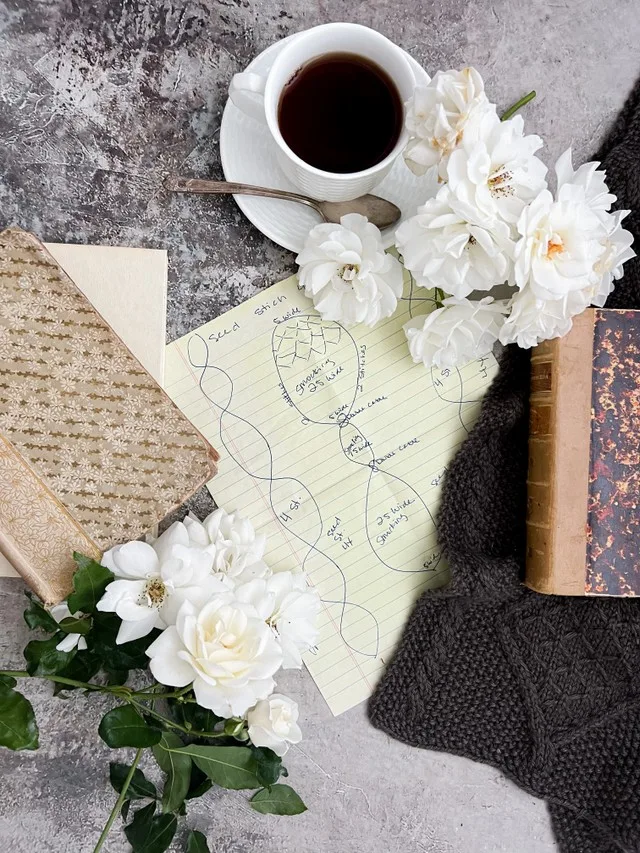
If your pattern is going to include charts, there are a few options for how you can do that. The simplest approach is to make a grid using Excel or Google Sheets and manually plug in the symbols. I use Stitch Mastery to make my charts, which has a one-time cost but is not a subscription. Other designers use other software, but I don’t have experience with those so I can’t recommend them one way or another.
If you are planning to publish this pattern for other people to use, I really strongly recommend that you enlist the help of a technical editor to make sure there are no mistakes. It is so easy to miss things in a pattern when we know what we meant to write. Remember, your work speaks for you, so you want to put out the most polished pattern you can.
Publishing, marketing, and selling your patterns is a whole separate kettle of fish, so I’ll leave things here for now! But let me know if there’s interest in a part two.
Let’s stay connected!
Join my newsletter for 30% off all new releases, regular updates with helpful tips and tricks, first crack at registration for upcoming workshops, exclusive discounts, and more.
I’m on YouTube now and would love to have you join me there for regular project updates, technique tips, chats about goings-on in the knitting world, and more.
Prefer to read without ads? Join my Patreon, which starts at just $1 a month!
Join the A Bee In The Bonnet Facebook Group to participate in knitalongs and other fun community events
Come hang out with me on the A Bee In The Bonnet TikTok
Follow along on the A Bee In The Bonnet Instagram
Get inspired via the A Bee In The Bonnet Pinterest